
Specialist Dementia Care Program
Dementia affects each person differently. Sometimes, dementia-related changes in behaviours require more support than can be provided in a mainstream care home. That's where the Specialist Dementia Care Program (SDCP) can help.
Support is available for health professionals and family carers. Download the flyer to learn more, or health professionals can make a referral with support throughout the process.


.jpg?width=2000&name=SDCP%20Image%20(cropped).jpg)
The role of family and service providers in the assessment process

Guide for Health Professionals
Your referral and ongoing support plays an important role in achieving positive outcomes for people living with dementia and their families. This video outlines the Specialist Dementia Care Program (SDCP), including who is eligible and how the referral process works.

Guide for Family Carers
We understand this can be an emotional and uncertain time for family carers. Concerns about ongoing care and what happens after the program are common. This video explains who SDCP is for, how the referral process works, and what to expect from the program.
Guide for Health Professionals
Your referral and ongoing support plays an important role in achieving positive outcomes for people living with dementia and their families. This video outlines the Specialist Dementia Care Program (SDCP), including who is eligible and how the referral process works.
Guide for Family Carers
We understand this can be an emotional and uncertain time for family carers. Concerns about ongoing care and what happens after the program are common. This video explains who SDCP is for, how the referral process works, and what to expect from the program.
Who is eligible for the Specialist Dementia Care Program?
Find out if someone you know or care for is eligible for more support through the SCDP Program.
- Are living with dementia
- Have complex care needs, including changes in behaviour or distress
- Require specialist support beyond standard care
- Are living at home, in residential aged care, or transitioning between care settings
How does the referral process work?
-
Health and aged care professionals
-
Hospitals or community services
-
In some cases, families or carers (if applicable)
What happens after referral:
- The referral is reviewed to confirm eligibility
- An initial consultation is arranged
- A specialist assessment is completed
- A tailored support plan is developed and shared with the care team
Support continues in collaboration with the person, their family and care providers.

Free referral guide
SDCP Referral Guide
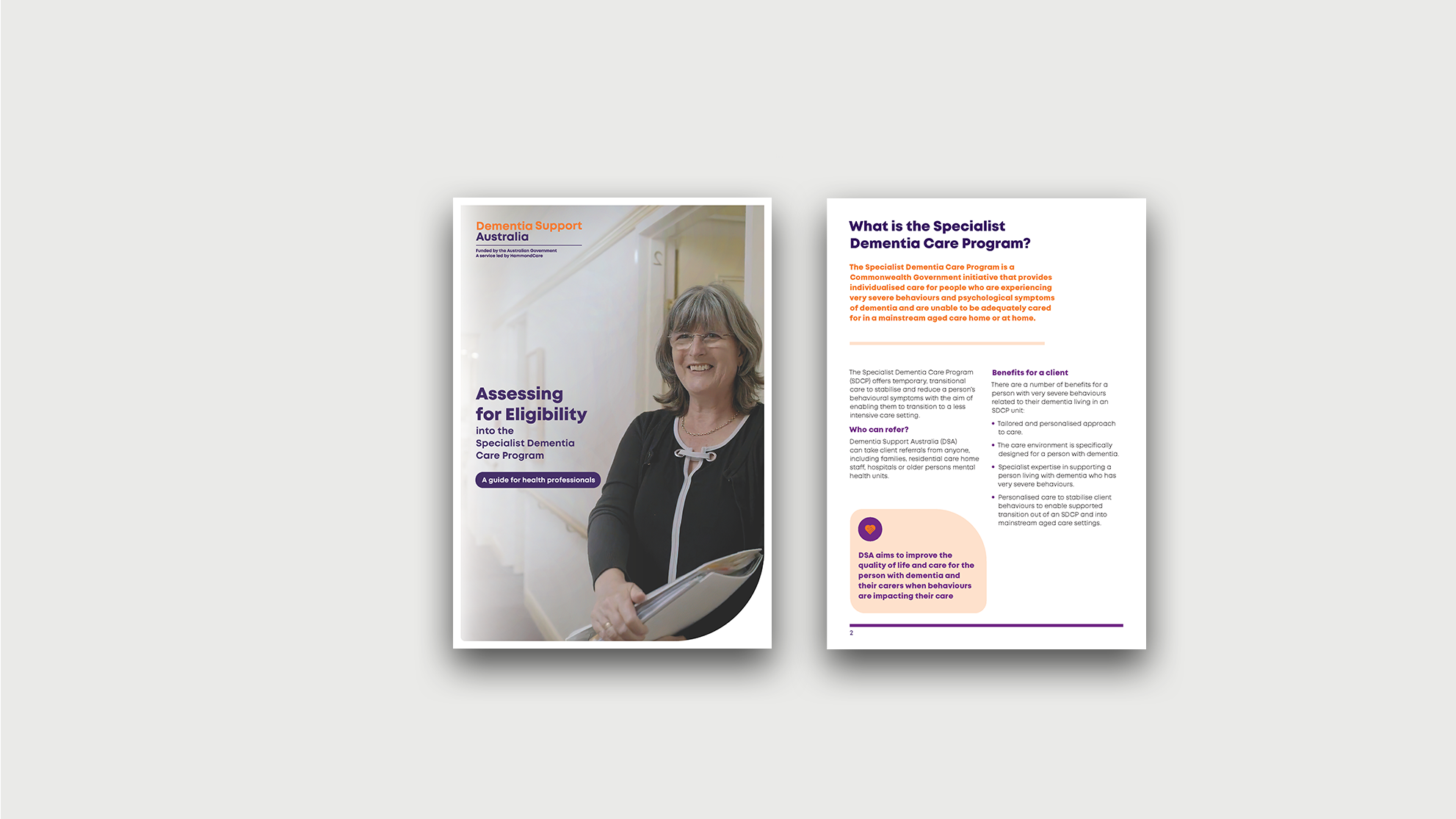
Dementia Support Australia SDCP referral guides are designed for carers supporting people living with severe dementia related behaviours. These resources explain who is eligible, how to make a referral, and the assessment and placement process.
The guide outlines how DSA works with carers and clinicians, timeframes to expect, and consent requirements. It also covers the role of SDCP Providers, and how DSA can support the person, family and care team throughout the journey.


Eligibility Assessment Process Step-Through
Step 1Referral

Step 1: Referral
When a person living with dementia is experiencing severe to very severe behavioural and psychological symptoms of dementia (BPSD) and are unable to be cared for in a standard residential care setting. Carers can refer them to the DSA eligibility assessment process for the Specialist Dementia Care Program (SDCP).
To be eligible, the behavioural and psychological symptoms of the person should be:
- Primarily as a result of dementia
- Severe or very severe, and
- They have not responded to support from other specialist services.
The person also requires having been assessed as eligible for placement in a residential care home and consent has been sought from the legally appointed person responsible for care.
Step 2Initial review

Step 2: Triage/Initial review
Upon receipt of the referral, DSA will schedule a phone consultation to understand the changed behaviours and review eligibility for the Specialist Dementia Care Program (SDCP). The initial review will look at:
- Clinical history.
- The severity of changed behaviours and their impact on the person and those caring for the person.
- Prior/current support from other specialist services.
- Whether consent has been sought from the legally appointed person responsible for care for the onsite assessment to proceed.
Step 3Eligibility assessment

Step 3: Eligibility Assessment
Following the initial phone consultation a DSA consultant will then schedule a comprehensive face-to-face eligibility assessment to determine if SDCP is the most appropriate care for the person.
The outcome of the eligibility assessment will be either:
- A recommendation that the person should be considered for care under the SDCP. In this case, with the person and their carer’s consent, the person’s information will be provided to the SDCP provider for a placement assessment; or
- A decision that the person should not be considered for care under the SDCP at this time. In this case, the person, carer and referring body will be notified of the decision. Advice will also be provided on alternative care options and assistance provided in accessing other support options through DSA or other specialist services that meet their care needs.
Step 4Placement

Step 4: Placement Assessment
Applicants eligible for the SDCP are then assessed by the Clinical Advisory Committee to determine their suitability for the SDCP if:
- The specialist dementia care unit is a ‘good fit’ for the person’s particular needs and behaviour triggers based on the current mix of clients and staffing profile.
- There are other relevant external factors that might affect the placement.
Once suitability has been confirmed, placement availability is reviewed. If there is a placement available, the SDCP provider will contact the referrer and the applicant will be placed into the support program.
If there are no available placements, the applicant is put on a waitlist and can access ongoing support through DSA or other specialist services. Once a placement becomes available, the applicant will be notified and assisted through placement.
Clients that are not assessed as eligible are provided assistance in accessing other support options either through DSA or other specialist services that meet their care needs.
Step 5Support

Step 5: Support and Transition
The focus of the SDCP is to support and reduce a person’s behavioural symptoms with the aim of enabling them to transition to a less intensive care setting.
Once placed, the SDCP provides temporary transitional care with:
- Tailored and personalised approach to care.
- A care environment specifically designed for a person with dementia.
- Specialist expertise in supporting a person with dementia.
- Personalised care to stabilise client behaviours to enable supported transition out of an SDCP.
Following completion of the program transition-out support is critical to the success of the program and ensuring that outcomes achieved during the client’s time in the program are sustained. DSA provides support to SDCPs and receiving mainstream providers to ensure a successful transition. This can include:
- DSA meeting with the family and care staff at the SDCP to gather information around behaviour triggers and de-escalation strategies. This information can be used to develop a plan to equip carers in the new care setting with skills to support the person’s changed behaviours.
- DSA visiting the new care environment to support staff in understanding and implementing the specific behavioural plan.
- Possible funding to support staff from the new care environment to visit the SDCP for information sharing and skills transfer in supporting the person.
- Possible funding of extra staff for a limited and agreed period during the initial transition to support the person as they settle into their new care environment.
- Funding of any items that facilitate meaningful engagement for the person.
Step 1: Referral
When a person living with dementia is experiencing severe to very severe behavioural and psychological symptoms of dementia (BPSD) and are unable to be cared for in a standard residential care setting. Carers can refer them to the DSA eligibility assessment process for the Specialist Dementia Care Program (SDCP).
To be eligible, the behavioural and psychological symptoms of the person should be:
- Primarily as a result of dementia
- Severe or very severe, and
- They have not responded to support from other specialist services.
The person also requires having been assessed as eligible for placement in a residential care home and consent has been sought from the legally appointed person responsible for care.
Step 2: Triage/Initial review
Upon receipt of the referral, DSA will schedule a phone consultation to understand the changed behaviours and review eligibility for the Specialist Dementia Care Program (SDCP). The initial review will look at:
- Clinical history.
- The severity of changed behaviours and their impact on the person and those caring for the person.
- Prior/current support from other specialist services.
- Whether consent has been sought from the legally appointed person responsible for care for the onsite assessment to proceed.
Step 3: Eligibility Assessment
Following the initial phone consultation a DSA consultant will then schedule a comprehensive face-to-face eligibility assessment to determine if SDCP is the most appropriate care for the person.
The outcome of the eligibility assessment will be either:
- A recommendation that the person should be considered for care under the SDCP. In this case, with the person and their carer’s consent, the person’s information will be provided to the SDCP provider for a placement assessment; or
- A decision that the person should not be considered for care under the SDCP at this time. In this case, the person, carer and referring body will be notified of the decision. Advice will also be provided on alternative care options and assistance provided in accessing other support options through DSA or other specialist services that meet their care needs.
Step 4: Placement Assessment
Applicants eligible for the SDCP are then assessed by the Clinical Advisory Committee to determine their suitability for the SDCP if:
- The specialist dementia care unit is a ‘good fit’ for the person’s particular needs and behaviour triggers based on the current mix of clients and staffing profile.
- There are other relevant external factors that might affect the placement.
Once suitability has been confirmed, placement availability is reviewed. If there is a placement available, the SDCP provider will contact the referrer and the applicant will be placed into the support program.
If there are no available placements, the applicant is put on a waitlist and can access ongoing support through DSA or other specialist services. Once a placement becomes available, the applicant will be notified and assisted through placement.
Clients that are not assessed as eligible are provided assistance in accessing other support options either through DSA or other specialist services that meet their care needs.
Step 5: Support and Transition
The focus of the SDCP is to support and reduce a person’s behavioural symptoms with the aim of enabling them to transition to a less intensive care setting.
Once placed, the SDCP provides temporary transitional care with:
- Tailored and personalised approach to care.
- A care environment specifically designed for a person with dementia.
- Specialist expertise in supporting a person with dementia.
- Personalised care to stabilise client behaviours to enable supported transition out of an SDCP.
Following completion of the program transition-out support is critical to the success of the program and ensuring that outcomes achieved during the client’s time in the program are sustained. DSA provides support to SDCPs and receiving mainstream providers to ensure a successful transition. This can include:
- DSA meeting with the family and care staff at the SDCP to gather information around behaviour triggers and de-escalation strategies. This information can be used to develop a plan to equip carers in the new care setting with skills to support the person’s changed behaviours.
- DSA visiting the new care environment to support staff in understanding and implementing the specific behavioural plan.
- Possible funding to support staff from the new care environment to visit the SDCP for information sharing and skills transfer in supporting the person.
- Possible funding of extra staff for a limited and agreed period during the initial transition to support the person as they settle into their new care environment.
- Funding of any items that facilitate meaningful engagement for the person.